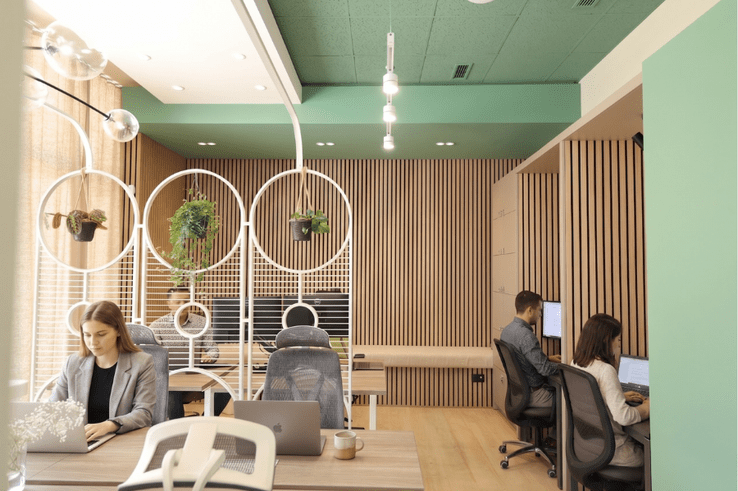
Although coworking spaces are becoming increasingly popular, many still have misconceptions about how they work. Some believe they are only for freelancers, others think they are too noisy for serious work, and still others that they are just a passing trend. It's time to separate the facts from the misconceptions and find out what coworking really looks like in practice.
Myth #1: Coworking is only for freelancers
Reality: Coworking has long been no longer reserved only for freelancers.
Today, these spaces are used by entrepreneurs, startup teams, remote workers, consultants, students, creatives, and companies that want to provide their employees with a more flexible work environment. What they have in common is that they are looking for a professional space where they can work more productively than at home or in a coffee shop.
Myth #2: There's too much noise in coworking for serious work
Reality: A well-organized coworking space encourages concentration, not distracts it.
Contrary to popular belief, coworking is not a place of constant conversation and distraction. Most users come precisely to focus on work. Interestingly, research is increasingly pointing to a phenomenon known as „body doubling“ – the presence of other people working can increase motivation and facilitate concentration.
Myth #3: Working from home is always cheaper
Reality: When considering all the costs and effects on productivity, the calculation is not always so simple.
Working from home involves the costs of internet, electricity, heating or cooling, as well as the potential loss of time due to household chores and distractions. For many people, coworking represents an investment in focus, efficiency, and a professional environment that helps them get work done faster and with better quality.
Myth #4: Coworking is more expensive than renting an office
Reality: For many individuals and small teams, coworking is a significantly more cost-effective solution.
Renting your own office often involves long-term contracts, overhead costs, furnishing the space and additional maintenance costs. U coworking Users receive fully equipped space, internet, shared facilities and business infrastructure, and pay only for the package that suits them. This is why coworking is often a more cost-effective solution, especially for freelancers, startup teams and small businesses.
Myth #5: Coworking is just a passing trend
Reality: Flexible work models are becoming the new business standard.
In recent years, the way we work has changed significantly. More and more companies are accepting hybrid and remote work, and coworking spaces are becoming an important part of that transformation. Instead of a passing trend, coworking has proven to be a long-term solution that meets the needs of modern professionals and teams.
Myth #6: Coworking is not for serious companies
Reality: Many successful companies use coworking spaces.
Coworking allows companies to reduce rental costs, quickly expand their team, or open a presence in a new city without a large investment. In addition to workspaces, modern coworking spaces offer meeting rooms, business infrastructure, and a professional environment that meets the needs of both small and large organizations.
Myth #7: You have to commit to a long-term lease
Reality: Flexibility is one of the biggest advantages of coworking.
Many spaces offer daily, weekly, and monthly packages, so users can choose the option that best suits their needs. Whether you need a space for one day, a few times a month, or daily work, coworking allows you to use the space for as long as you really need.
Conclusion
Most of the myths about coworking are born from outdated or incomplete information. In reality, coworking is a flexible and professional work environment that can suit a wide range of people – from freelancers and students to entrepreneurs and companies.
If you've never worked from a coworking space, the best way to see if it's right for you is to try it out. You may find that this environment helps you be more focused, productive, and satisfied with your workday.






Leave a comment